LIFE BOYS
At least as early as 1909 Carey Longmore had set up a Junior Section for pre B.B. age boys, which it would seem formed the basis for what was to come about eight years later. This was an unrecognised organisation that would not have been in conflict with the Brigade constitution, as their activities would have been entirely separate from that of the B.B.
It is not known if Carey was the first to introduce a junior section, because it is thought that there were some Companies who were catering for pre B.B. age boys before an official organisation was set up. It is possible, as a result of hearing of Carey’s initiative in introducing younger boys into the Brigade that other Companies followed his example.During the first Great War, the result of the absence of the fathers on Active Service had a most serious effect on Sunday School attendance throughout the United Kingdom. Very few boys of over 9 years of age were found in the Sunday Schools. It was to replace this leakage that Carey suggested to the Boys' Brigade Executive in 1917 that the BB should start a separate Organisation for Boys between the ages of 9 and 12 years, making attendance at a Sunday School the condition of membership. He was asked to draw up a Constitution and to prepare a training Manual.
In 1917 the Constitution and Manual were approved and the Movement named the “Boy Reserves” was sanctioned.
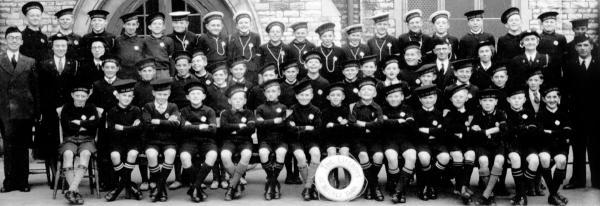
The first recognised Team of these younger boys was formed and met at the Garden Room, the headquarters of the 1st Warley Company, on which was modelled all future Teams. These boys became widely and affectionately called "Carey's Chicks".
The title “Boy Reserves” was changed to The Life Boys in 1926 following the union of the Boys Brigade and the Boys' Life Brigade, which had a junior section formed in 1921, called “Lifeboys”.
The Birth of the First Team
Carey shares with Tom Ellis the progress of the formation of this new Movement, in an extract from a letter of March 1918.
The Boy Reserves is booming. 20 sections are already enrolled and large numbers of others are holding their first drills prior to enrolment. I am bringing out the Handbook in monthly parts in the "Boys Brigade Gazette". The 1st Warley Section is being run as the model and its weekly programme is published with notes. The Section is going with a great swing, we have 29 smart keen little Boys. Their outfit costs 8s a head and they pay for it as they please, but only get what they pay for. In consequence, eighteen are fully equipped in Jersey, Shorts, caps and breast badge, the others are variegated and on their way to perfect beauty! They have paid £5-16s. So far our staff consists of two
"Honorary Instructors" a lady and Sergeant Coe (Dick) and myself. Dick is Quartermaster (does all buying, fitting, collecting, recruiting and marking, also is games organiser and assists with physical training). The lady (the captain of the Girl Guides) instructs in handicrafts. She has taught them to make soft toys such as teddy bears, rabbits ducks, elephants and now they are going to have a course of cane basket work. My duty is timekeeper and storyteller. Afterwards we have a happy little Service in the Chapel........"
Preparation of Life Boys' Handbook
In a further letter to Tom Ellis of September 6th 1918, Carey relates the preparation of the Handbook for the newly formed Boy Reserves. It is most likely he was helped in this from the practical experience gained from the boys in the 1st Warley.
My Dear Tom
I am afraid you must think me a very ungrateful chap. Wrong again! I am only worked up to the limit. I will return to this later.
Thanks so much, how I prize your gift and prayers I cannot say.
I am delighted to hear of the Sunday School, how very encouraging the numbers are. It shows how badly it was needed.
Now to return to why I am so rushed. The Annual Council Meetings of the BB Council are to be held on Friday to next Monday. The new Handbook for the Boy Reserves has to be in type and passed by the Executive at the Council meetings so as to be on sale before opening of the Session on the last Monday in September. It was entrusted to Douglas Smith and me to compile, we divided up the subjects roughly between us about half each.
Since we started he has got a Commission in the R.N.A.S. (now R.A.F.). Well apparently his training has so occupied his time that only a month before the meeting, he found it hopeless to complete his part, I have had to undertake it, and it has driven me to such an extent that I could answer no letters and had to drop all engagements for a fortnight except Sundays. You see hundreds of men are waiting to start work on this book. So forgive me - I know you do!
So far there are 96 Sections of the Boy Reserves and 2,400 Boys, and that before the Handbook is published. I have a young crowd of overdue letters to write. Yours is the first.
Yours very affectionately
The Old Captain
Carey Longmore and the Warley Company is Honoured
Carey was appointed Honorary Director of the Movement. On his retirement in 1938 from the Brigade Executive to which he was first elected in 1912, The Boys Brigade Executive showed its appreciation of the work that the 1st Warley Company had undertaken for the Boys' Brigade, by appointing Carey as Honorary Vice-President of the Boys' Brigade.
Also on his resignation in 1938 from Honorary Directorship of the Movement, he was presented with a bronze statue of a Life Boy and a cheque of £263 to build "The Carey Longmore Dispensary" in Northern Nigeria. This was reported as follows at the time:
The "coming of age" (under the title of The Boy Reserves), by Mr. F.C. Longmore.
The presentation was made by Mr. J.H. Early J.P., Chairman of the Life Boy Committee in a speech of singular charm befitting the historic occasion and it brought the great audience of 600 officers to their feet to make the rafters ring with the strains of the accustomed musical honours never rendered with more wholehearted enthusiasm. We all hope he realised what a "millionaire of love" he is recognised to be. One cannot fail to have been moved by the characteristic charm and deep sincerity of his response. We all feel he realises now, better than before how truly we love him and how we delighted to honour him.
For our part we feel and know that the Boys' Brigade movement as a whole and The Life Boys in particular did itself great honour that day at Dunoon.
By the time of Carey's passing in 1950 there were 2,233 Teams with 58,113 Boys in the British Isles.
At the time of Carey's death the bronze statuette was given to The Boys’ Brigade headquarters.
Since 1966 The Life Boys have been fully integrated into the wider aspects of the Boys’ Brigade to become known as the Junior Section.